New vs. Used: Which Is the Better Vehicle Value for Michigan Drivers?
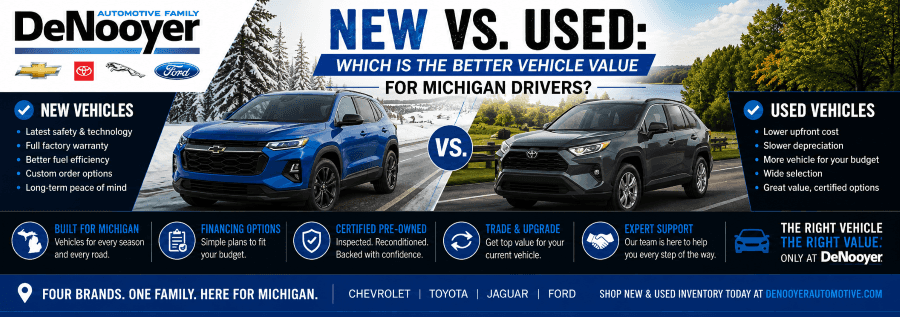
New vs. Used: Which Is the Better Vehicle Value for Michigan Drivers?
When it is time to replace your current vehicle, one of the biggest decisions is whether to buy new or used. Both options can deliver strong value, but the better choice depends on your budget, driving habits, ownership goals, and the features that matter most.
There Is No One-Size-Fits-All Answer
A new vehicle offers the latest technology, full manufacturer warranty coverage, and no prior ownership history. A used vehicle may provide a lower purchase price, reduced early depreciation, and the opportunity to get more features or a higher trim level for the same budget.
New vs. Used at a Glance
| Category | New Vehicle | Used Vehicle |
|---|---|---|
| Purchase Price | Typically higher | Typically lower |
| Warranty | Full manufacturer coverage | Varies by age, mileage, and certification |
| Technology | Newest available features | Depends on model year and trim |
| Depreciation | Greater early depreciation | Some initial depreciation already absorbed |
| Vehicle History | Known from day one | Should be reviewed before purchase |
| Configuration Choice | More opportunity to choose exact features | Limited to available inventory |
Why Buy a New Vehicle?
Buying new gives you access to the latest models, current powertrains, updated safety technology, modern connectivity, and the confidence of being the vehicle’s first owner.
A new vehicle starts ownership with the manufacturer’s original warranty coverage in place.
New models offer the most current infotainment, connectivity, safety, and driver-assistance features.
You know how the vehicle has been driven and maintained because you are its first owner.
Shopping new gives you access to the latest gasoline, hybrid, plug-in hybrid, and electric options.
You may have more flexibility to choose the trim, color, drivetrain, packages, and features you want.
Manufacturer incentives or special financing offers may be available on select new vehicles.
When Buying New May Make the Most Sense
Why Consider a Used Vehicle?
For many shoppers, buying used is a practical way to stretch the budget further while still getting the space, comfort, features, and capability they need.
Pre-owned vehicles often cost less than comparable new models.
Someone else may have already absorbed part of the vehicle’s greatest initial depreciation.
A used vehicle may allow you to move into a larger model or higher trim level.
Used inventory opens the door to multiple generations, equipment combinations, and price points.
New May Be the Better Value If…
- You want the latest safety and connectivity features.
- You value full manufacturer warranty coverage.
- You plan to keep the vehicle long term.
- You want to choose the exact configuration.
- You want access to the newest powertrain technology.
Used May Be the Better Value If…
- Your priority is lowering the purchase price.
- You want to avoid more of the early depreciation.
- You want a higher trim level within your budget.
- You are open to multiple model years.
- You prefer maximizing features for the money.
Consider the Vehicle’s History
Condition and maintenance history become especially important when shopping for a used vehicle. A lower price does not automatically mean better value if a vehicle has been poorly maintained.
Do Not Skip the Test Drive
A thorough test drive gives you a chance to evaluate more than just performance. It can also reveal whether the vehicle feels right for your everyday routine.
What About Certified Pre-Owned Vehicles?
Certified Pre-Owned vehicles can provide a middle ground between buying brand-new and choosing a traditional used vehicle.
Manufacturers typically establish specific age and mileage limits for vehicles entering their CPO programs.
Qualifying vehicles generally must complete a manufacturer-defined inspection before earning certification.
CPO programs may include additional warranty protection beyond what is available on a traditional used vehicle.
Coverage and ownership benefits vary by manufacturer, so review the exact program before purchasing.
Think Beyond the Purchase Price
The sticker price is only one part of a vehicle’s overall value. Looking at expected ownership costs can give you a more accurate picture of what fits your budget.
Purchase Price vs. Total Ownership Value
| Consideration | New Vehicle | Used Vehicle |
|---|---|---|
| Upfront Cost | Usually higher | Often lower |
| Warranty Protection | Typically greater at purchase | Depends on vehicle and program |
| Maintenance Risk | Generally lower early in ownership | Can increase as age and mileage rise |
| Depreciation | More significant early depreciation | Some early depreciation already occurred |
| Features for the Money | Newest equipment and technology | May offer a higher trim for the same budget |
Questions to Ask Before You Decide
Which Is Better for You?
Choose New If…
You prioritize the newest technology, full warranty coverage, current safety features, access to the latest powertrains, and the ability to choose your preferred configuration.
Choose Used If…
Purchase price, reduced early depreciation, and getting more vehicle or a higher trim level for your budget are your biggest priorities.
You Don’t Have to Decide Before You Shop
Comparing new and used vehicles side by side can show you exactly what your budget can buy. You may find that a new model fits better than expected, or that a pre-owned vehicle gives you more of the features you want.
Why Shop with DeNooyer Automotive?
DeNooyer Automotive gives Southwest Michigan shoppers access to new and pre-owned vehicles across multiple brands, making it easier to compare different models, price points, features, and ownership options.
Compare both ownership paths instead of limiting your search from the start.
Explore different manufacturers, body styles, powertrains, and price ranges.
Evaluate trims, mileage, equipment, technology, condition, and overall ownership value.
Find a vehicle that fits your commute, family needs, seasonal driving, and long-term plans.
Shop New and Used Vehicles at DeNooyer Automotive
You do not have to decide between new and used before you begin shopping. Explore both at DeNooyer Automotive and compare vehicles across multiple brands, price points, features, and ownership options to find the combination of value, capability, comfort, and technology that fits your Michigan lifestyle.
Shopping Note: Vehicle pricing, warranty coverage, financing offers, incentives, certification requirements, condition, mileage, and ownership costs vary by vehicle, manufacturer, model year, and individual circumstances. Review the specific vehicle, available history information, warranty terms, and applicable program details before making a purchase decision.