AWD vs. 4WD in Michigan
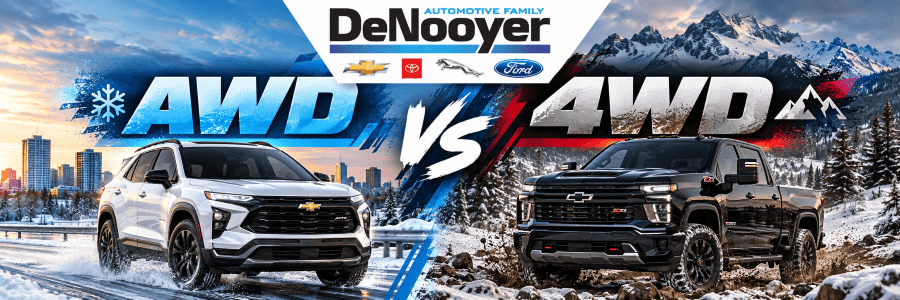
AWD vs. 4WD in Michigan: Which Is Better for Snow, Ice, and Everyday Driving?
Michigan drivers experience a wide range of road conditions throughout the year, from heavy snowfall and icy highways to rain-soaked streets and muddy backroads. Choosing a vehicle with the right drivetrain can make a difference in traction, handling, and everyday driving confidence.
Two popular options are all-wheel drive (AWD) and four-wheel drive (4WD). While both systems help distribute power between the front and rear wheels, they operate differently and are designed for different driving needs.
For drivers around Kalamazoo, Portage, Battle Creek, and Southwest Michigan, understanding the differences between AWD and 4WD can help you choose the right vehicle.
AWD vs. 4WD: What’s the Main Difference?
AWD typically manages traction automatically, making it convenient for daily driving on wet, snowy, and changing road surfaces. 4WD is commonly associated with trucks and rugged SUVs, with many systems offering selectable driving modes and additional capability for deep snow, mud, and off-road conditions. Actual performance depends on the vehicle, drivetrain design, and tires.
Understanding All-Wheel Drive and Four-Wheel Drive
What Is All-Wheel Drive (AWD)?
|
What Is Four-Wheel Drive (4WD)?
|
Two Drivetrain Systems. Different Strengths.
AWD and 4WD both help provide traction, but their typical operation and intended applications differ.
AWD
|
4WD
|
AWD vs. 4WD: Key Differences
| Feature | All-Wheel Drive (AWD) | Four-Wheel Drive (4WD) |
|---|---|---|
| Primary Purpose | Everyday traction | Rugged terrain and demanding conditions |
| Operation | Often automatic | Often selectable |
| Snow-Covered Roads | Very capable | Very capable |
| Off-Road Driving | Light to moderate, depending on vehicle | Often better suited |
| Low-Range Gearing | Generally unavailable | Available on many systems |
| Fuel Efficiency | Often better, depending on vehicle | Varies by system and vehicle |
| Common Vehicles | Sedans, crossovers, SUVs | Trucks and off-road SUVs |
Capabilities vary by manufacturer, drivetrain design, tires, and vehicle configuration.
Is AWD or 4WD Better for Michigan Winters?
Both AWD and 4WD can improve traction when accelerating on slippery roads, but neither system automatically makes a vehicle safer on ice.
AWD for Winter Commuting
|
4WD for Deep Snow and Rural Roads
|
Why Winter Tires Matter More Than Drivetrain Labels
Winter tires are one of the most important factors in winter driving performance. AWD and 4WD help vehicles gain traction when accelerating, but neither eliminates the need for proper tires, safe following distances, and careful braking.
Winter tires can improve traction during acceleration, cornering, and braking in cold conditions. Even a vehicle with advanced AWD or 4WD benefits from tires designed for snowy and icy roads.
Which Drivetrain Is Better for Everyday Driving?
For most Michigan commuters, AWD offers a convenient combination of traction and everyday usability. Traditional 4WD vehicles may be better suited for drivers with more demanding transportation needs.
AWD: Convenient Daily Transportation
|
4WD: Capability Beyond Paved Roads
|
When comparing options, shoppers should consider the specific drivetrain system rather than relying on the AWD or 4WD label alone.
Should You Choose AWD or 4WD?
The best choice depends on your driving habits and the conditions you encounter most frequently.
Choose AWD If…
|
Choose 4WD If…
|
Both systems can provide useful traction, but the right tires and safe driving practices remain essential.
Find AWD and 4WD Vehicles at DeNooyer Automotive Group
Whether you’re searching for an AWD crossover for your daily commute or a capable 4WD truck for work and outdoor adventures, DeNooyer Automotive Group can help you explore your options.
Browse available new and pre-owned cars, trucks, and SUVs with AWD and 4WD capabilities. Serving Kalamazoo, Portage, Battle Creek, Vicksburg, and surrounding Southwest Michigan communities, DeNooyer Automotive Group can help you find a vehicle suited to Michigan’s changing road conditions.
AWD and 4WD capabilities vary by manufacturer, vehicle, drivetrain design, tires, and configuration. Not all 4WD systems include low-range gearing, and some offer automatic operating modes. Neither AWD nor 4WD eliminates the risks associated with snow and ice. Always use appropriate tires, follow manufacturer operating instructions, and adjust driving behavior to road conditions.